Fourteen days
We know what happened on the road because Donal Cam’s young kinsman Philip, who was a boy at the time and safe in Spain, grew up to write it down from the accounts of men who had been there.
They were attacked on the first day and nearly every day after it. Local lords, Irish as well as English, were anxious to prove their loyalty to the winning side, and a column of starving refugees was an easy way to do it. They marched twenty and thirty miles at a stretch, fighting a rearguard action as they went. They ate what they could find, which in January was very little. The old and the wounded fell out and were left, because there was no way to carry them.
After a week they reached the River Shannon at Redwood, in Tipperary, and found it wide, freezing, in flood, and with every boat removed from the near bank. It was there that they did the thing the march is remembered for. They killed eleven of their horses. They ate the meat. They stretched the hides over frames of woven osier cut from the riverbank, in the manner of the old Irish curach, and in two days they had built a boat that would carry thirty men at a time. They crossed by night, under attack, ferrying back and forth.
At Aughrim, in Galway, they found their way barred by a force of cavalry and foot far larger than their own. There were perhaps three hundred of them left by then, of whom fewer than half could fight. Donal Cam told them plainly that there was nowhere to run to and that they might as well die facing forward. They attacked, killed the enemy’s commander, and broke through.
On 14 January 1603 they came to O’Rourke’s castle at Leitrim. Philip gives the number who walked in through the gate. Thirty-five. Eighteen soldiers, sixteen servants and one woman.
Others straggled in over the following days, and some who had dropped out along the way had found shelter and survived. But of the thousand who set out, thirty-five arrived together. Donal Cam sailed to Spain, was made a count by the Spanish king, and was stabbed to death outside a church in Madrid in 1618. He never saw Beara again. The route he took is now a waymarked walking and cycling trail, the Beara-Breifne Way, the longest in Ireland.
The name that went everywhere
O’Sullivan is Ó Súilleabháin in Irish, and it is the commonest surname in Munster and one of the commonest in all Ireland. The family belonged to the Eóganacht, the royal kindred of the south in the early Middle Ages. Their first home was in the rich land of Tipperary. The Normans drove them out of it in the 1190s, into the mountains of Cork and Kerry, where they split into two great branches: O’Sullivan Mór around Kenmare, and O’Sullivan Beare on the peninsula that still carries their name.
Both lost everything in the seventeenth century. Their people stayed on as tenants and fishermen, and when the copper mines at Allihies on Beara failed and the famine came, they left in tens of thousands. So many went from Beara to the copper mines of Butte, Montana, that the town had a Sullivan on every street. They went to Boston, to New York, to Sydney. There are far more of them now outside Ireland than in it.
A young tartan for an old name
Here it is worth being straight about something, because people ask.
The clan tartan system is Scottish, and mostly nineteenth-century at that. Gaelic Ireland had a splendid tradition of dress of its own, the saffron-dyed linen shirt, the heavy fringed mantle, and some Irish cloth was certainly striped and checked. But Irish families did not have named patterns.
Irish kilts came with the cultural revival of the 1890s and 1900s, when nationalists looking for a national costume adopted a plain kilt in saffron or green. Irish pipe bands wear the saffron kilt still. Tartans came later again. A set of Irish county tartans was designed in the 1990s, and tartans for individual Irish surnames began appearing around the same time. Many now buy the whole look at once as an outfit kilt: kilt, jacket, sporran and hose chosen to match.
The O’Sullivan is one of those. The tartan registers date it to about the year 2000 and note that it was designed for one of the most numerous names in Ireland. A separate sett for O’Sullivan Beare, in black, white and grey, was designed a few years afterwards and approved by the head of that house.
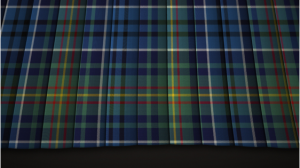
So the O’Sullivan tartan is a new cloth for an ancient name, and there is nothing wrong with that. Every Scottish clan tartan was new once. It is a fine, clear design: a strong royal blue ground with bands of darker blue and soft green, crossed by fine lines of white, red and gold. It looks like the Atlantic off Beara on a good day. Retailers offer it made to order as kilts, skirts, waistcoats, ties and sashes, and by the yard.
Boston, the second Saturday in June
Kevin O’Sullivan is getting married, and his grandmother has opinions.
She is ninety-one. Her own grandfather came to Boston from Castletownbere in 1889 with a cardboard suitcase. She has been to the old country twice, has walked a stretch of the Beara-Breifne Way on two sticks, and has told the story of the march at every family gathering for sixty years, with the number thirty-five delivered in a whisper at the end. When Kevin mentioned that he was thinking of wearing a kilt, she said, “Well, I should hope so.”
He had not known there was an O’Sullivan tartan. He had not known, either, that there was such a thing as Irish formal dress, and that he did not have to borrow a Scotsman’s jacket.
There are two Irish jackets. The Brian Boru is the evening one, short and cut away at the front to show the waistcoat, with satin lapels, like the Scottish Prince Charlie, but with a shamrock or a harp on the buttons where the Scots put a thistle. The Kilkenny is the day jacket, a little longer and plainer, traditionally in deep green, with its own distinctive cuff. For a two o’clock church wedding and a reception that would run into the night, Kevin chose the Kilkenny. Green over that blue looked, his fiancée said, like it had been planned by somebody with taste, which she took to mean not him.
The harder question was how to get six men dressed. A kilt outfit is a system of parts: kilt, jacket, waistcoat, shirt and tie, sporran, hose and flashes, kilt pin, brogues. They have to agree with each other, and if several men are wearing the same tartan, the cloth must come from one batch, because blue is a colour where the smallest difference in shade shows. The answer was to order the outfit kilt, jacket, waistcoat and accessories together, as a package, from a single maker. Specialists sell complete outfits for grooms, groomsmen, fathers and guests in exactly this way, with the tartan pieces cut from one run of cloth: Prince Charlie and Argyll packages for the Scottish side of any family, Brian Boru and Kilkenny for the Irish.
He had all six of them measured in one evening in his apartment, by the same person with the same tape. Waist at the navel, hips, waist to mid-knee, chest, sleeve, shoe size. He sent it in fourteen weeks before the day, because a tartan like this is often woven to order and he was not going to be the man who explained to his grandmother why it had not arrived.
On the morning, his brother dressed him. Kilt high on the waist, hem at the middle of the knee. Sporran a hand’s width below the waistcoat. Hose up, garters on, cuffs turned down so the flashes showed. Kilt pin through the front apron only. All the metal in the same antique finish, harp on every button.
His grandmother was waiting in the front pew. She looked him up and down for a long time.
“Your great-great-grandfather,” she said, “had one pair of trousers.”
Then she took his hand, and he saw that she was crying.
Thirty-five
Donal Cam O’Sullivan Beare walked out of Glengarriff with a thousand people and into Leitrim with thirty-five. By any ordinary measure the march was a catastrophe, and it was the end of his world.
But it is the reason the name is remembered. A family that could do that, people said, could survive anything, and they have. They took the name from Tipperary to Beara, from Beara to Leitrim and Spain, from Castletownbere to Butte and Boston and Sydney. The blue tartan is only the newest way of carrying it. Worn up the aisle of a church in Massachusetts, under a green jacket with a harp on the buttons, it says that the family is still here.
